
Junyeong Choi (Undergraduate Student)
 |
Undergraduate Student (B.S), Embedded System-on-Chip Integrator |
Repository Commit History
 |
Introduction
Full Bio Sketch
Mr. Choi is currently pursuing his undergraduate degree in Electronic Engineering at Kyungpook National University, Daegu, Republic of Korea. His research interests include embedded systems, computer architecture, signal processing, parallel and concurrent processor design, and hardware?software co-design for efficient data-processing systems.
He has worked on RISC-V processor implementation, FPGA/RTL-based hardware design, and low-power keyword spotting architectures. His current research focuses on efficient processor and accelerator architectures using custom instructions, as well as real-time embedded computing systems.
Research Topic
Sparse Scout-Guided Scheduling for Low-Power Always-On Keyword Spotting
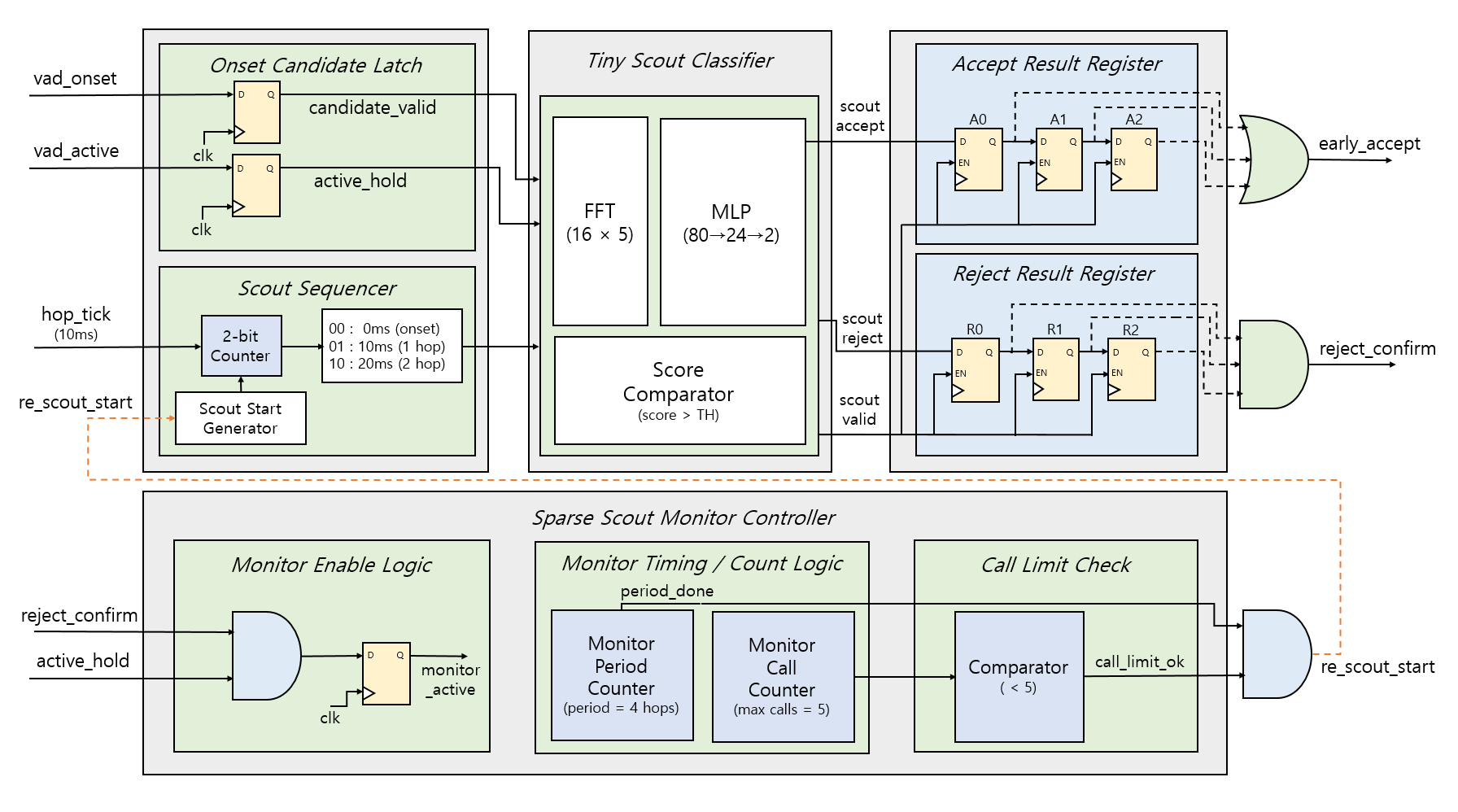 Always-on keyword spotting (KWS) requires continuous audio monitoring, but repeatedly executing the main neural network for every input window causes unnecessary computation and memory-access overhead. My research focuses on a low-power KWS architecture that combines an FFT-based log-mel front-end, a lightweight scout network, and a Tiny Depthwise Separable Convolutional Neural Network (DS-CNN) classifier. The scout analyzes short speech segments and selectively activates the main classifier only when a meaningful keyword candidate is detected. A Sparse Scout Monitor periodically re-evaluates inactive intervals to reduce missed detections, while posterior-margin re-checking, voting, and refractory control suppress false triggers caused by speech-like noise. This architecture reduces main-network executions and average computational cost while maintaining keyword recall, making it suitable for resource-constrained always-on speech interfaces.
Future Research Interests
My future research interests lie in processor?accelerator co-design for low-power, real-time AI systems. Building on my keyword-spotting research, I plan to investigate RISC-V-based architectures that integrate custom instructions, shared neural-network processing resources, and slot-based feature buffering. In particular, I am interested in enabling software to efficiently control scout and main-network execution while the hardware accelerator handles computation-intensive neural-network operations. I would also like to explore streaming execution, memory-access reduction, and hardware?software scheduling techniques for various time-series signals beyond speech, including biomedical and sensor data.
Publications
Journal Publications (SCI 0, KCI 1)
Junyeong Choi and Daejin Park. Sparse Scout Monitor-based Soft-Gated Scheduling for Always-On Keyword Spotting (KCI) Journal of the Korea Institute of Information and Communication Engineering, 2026.
Conference Publications (Intl. 1)
Junyeong Choi and Daejin Park. Low-Power Always-On Keyword Spotting with Adaptive FFT and Hierarchical Control (Under Review) In 2026 IEEE Global Conference on Consumer Electronics (GCCE 2026), 2026.
Participation in International Conference
IEEE GCCE 2026, Kobe, Japan
Last Updated, 2026.08.01
)